

by Xinhua writers Li Kun and Li Yating
TIANJIN, June 5 (Xinhua) -- Under the scorching sun on the South China Sea, an LNG-powered vessel looked unremarkable at first glance. But inside, a smart brain hummed, delivering crucial support for offshore oil extraction.
The intelligent standby vessel "Hai Yang Shi You 547" features a smart integrated platform and several intelligent systems, including those for energy efficiency and navigation, enabling it to perceive, analyze and even predict.
Wang Guanghe, a digital engineer at China Oilfield Services Limited, said the vessel could integrate and analyze information on navigation, hydrology, and weather to offer optimal sailing recommendations. It could also monitor equipment performance in real time and identify potential faults in advance.
Such smart vessels are part of a broader push to digitalize China's entire shipping sector, a trend on full display at the Fourth Tianjin International Shipping Industry Expo, held in north China's Tianjin Municipality this week.
Themed "Shipping to the World and Navigating towards the Future: AI Leads New Opportunities for the Development of Ports and Shipping," the expo gave visitors a glimpse of advanced facilities and technologies in the industry.
Shipbuilding is also getting smarter. At the booth of Emergen Technology Group Co., Ltd., an intelligent, flexible welding robot with a 3D vision system was swinging its robotic arm. "It is now widely used in ship manufacturing," said Zhang Feng, a testing engineer at the company.
"The robot speeds up welding and improves quality, even on complex curved surfaces and varied product types," said Zhang, who noted that the robot could figure out the shape and position of the weld seam and intelligently plan the best path for welding.
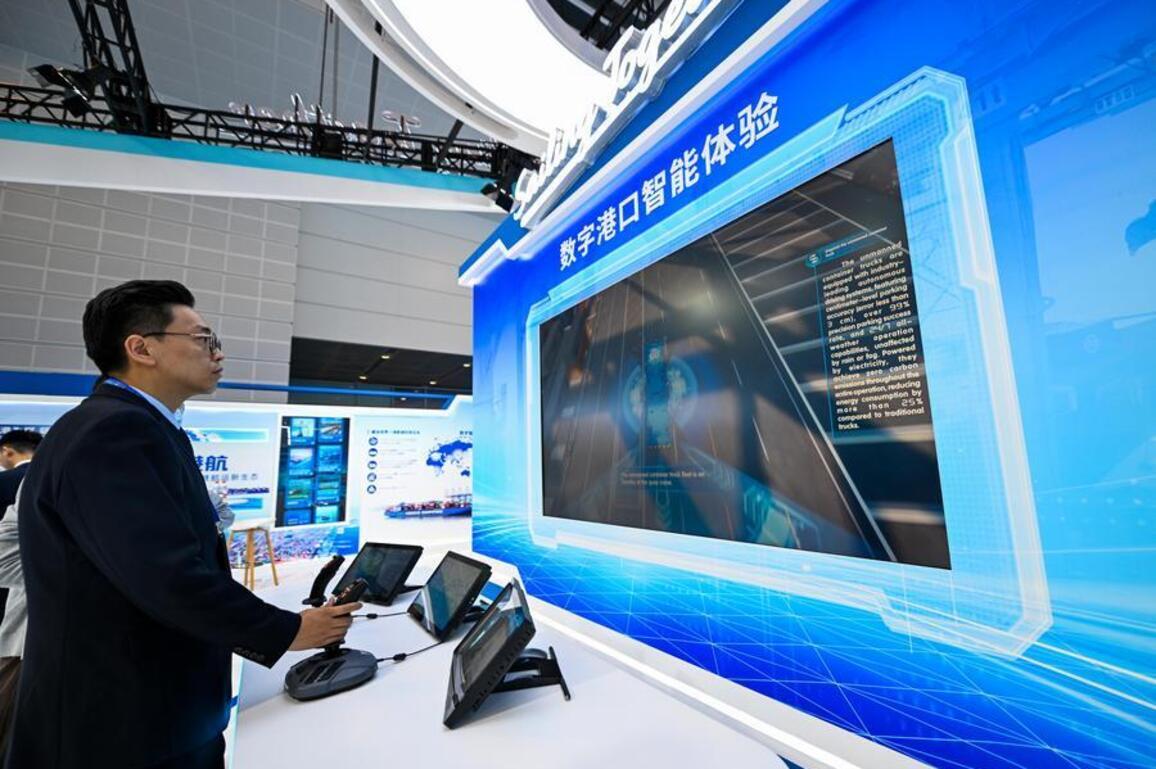
Beyond shipbuilding, AI is also transforming terminal operations. At the expo, participants could use two joysticks to simulate operating a container crane on a large screen. Similar remote-control technologies have been deployed in real-world operations.
At the world's first smart zero-carbon terminal at Tianjin Port, crane operators handle cargo remotely from several hundred meters away while autonomous vehicles move containers across the yard. "We've used AI to speed up digital transformation and make our port and shipping operations smarter," said Chu Bin, chairman of Tianjin Port (Group) Co., Ltd.
Smart devices are also improving cargo logistics. Liao Gaojun, a client manager of the Tianjin Keepsens Information Technology Co., Ltd., introduced a small, rectangular white device to Xinhua.
Liao cited an example where containers carrying beer were fitted with the device. Whenever the internal temperature changed, the manufacturer received an alert and could make adjustments immediately, ensuring that the beer's taste and quality were maintained.
"When attached to a shipping container, it can track the container's real-time location and internal temperature, humidity and other information," said Wang Xu, business manager of the company, noting that it greatly improves container utilization, simplifies the operations and maximizes cargo security.
"Terminal equipment requires AI to evolve from executing commands to autonomous reasoning," said Xu Kai, chief information officer of the Shanghai International Shipping Institute. Xu added that China has made notable breakthroughs in areas including intelligent guided vehicles.
Li Xinghu, Chinese vice minister of transport, said at the expo that China has developed the world's largest port cluster. The country's port cargo throughput and container throughput have ranked first in the world for over 20 consecutive years. China's share of international shipping volume accounts for nearly one-third of the global total, and its shipping service network now covers the entire globe.
China has emerged as the world's largest ship-owning nation, boasting the most valuable fleet of bulk carriers and container ships globally. According to the Chinese Ministry of Transport, China has built 30 automated container terminals, representing 27 percent of the world's total, and 30 automated dry bulk terminals.
"More importantly, China represents something important about the future of shipping, not just the scale, not just infrastructure, but the combination of connectivity, technology and intelligence," said Waqas Samad, CEO of Lloyd's List Intelligence.